Published: September 2026 | Technical Risk & Insurance Strategy Guide
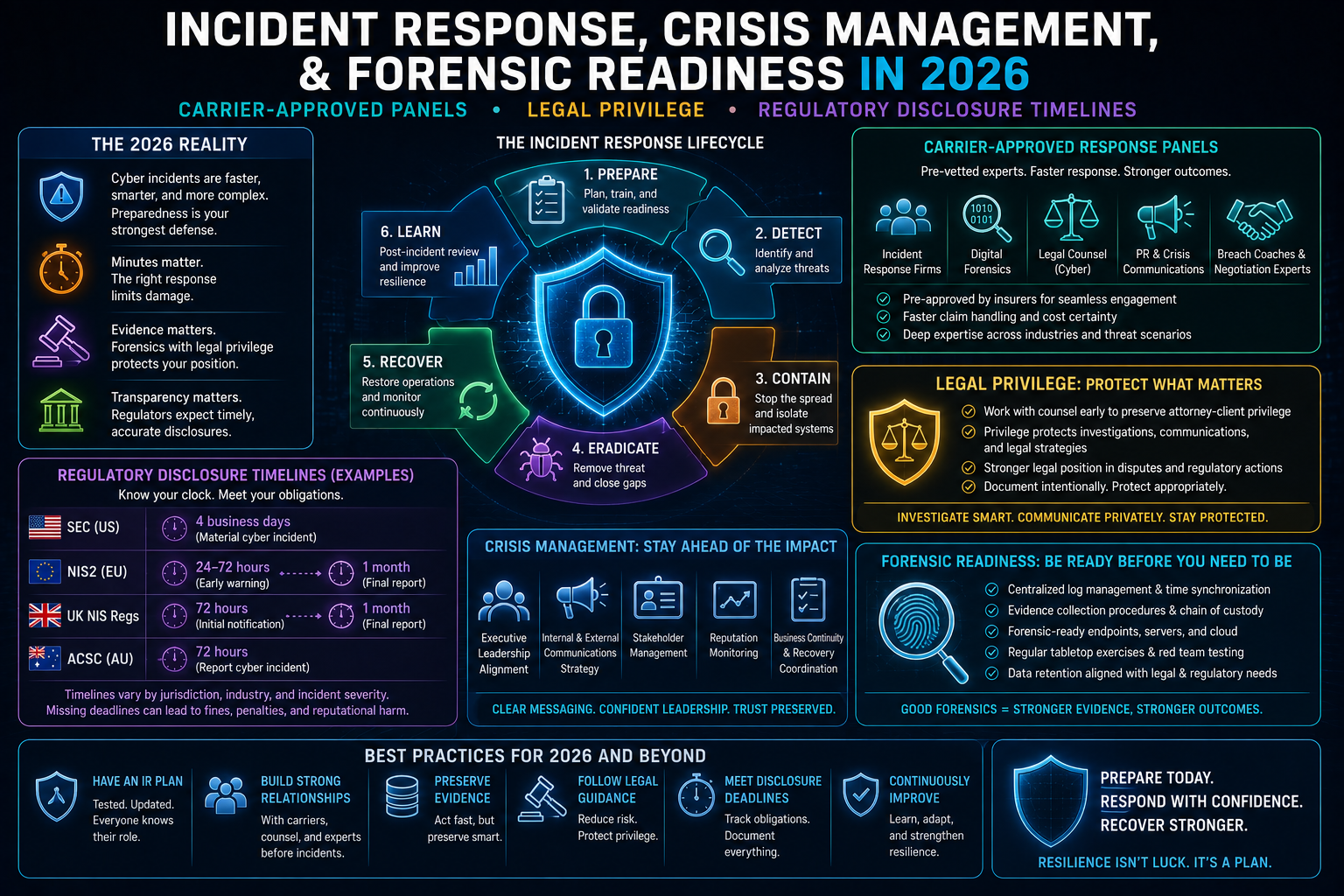
When a major cyber incident strikes, the speed and structure of the initial response dictate both operational recovery and insurance claim approval. Modern cyber insurance policies do not merely function as financial safety nets; they operate as tightly regulated response ecosystems requiring strict adherence to pre-approved vendor panels, legal privilege protocols, and immediate carrier notification mandates.
In 2026, regulatory bodies have compressed breach notification windows down to as little as 24 to 72 hours, while insurers enforce rigorous forensic documentation standards before releasing claim payouts. Failure to engage pre-approved digital forensics and incident response (DFIR) vendors or mishandling attorney-client privilege can inadvertently void policy coverage and lead to severe regulatory fines.
This technical guide examines the legal and technical requirements of incident response, carrier panel dynamics, forensic readiness baselines, real-world claim scenarios, and an actionable CISO crisis framework.
The Compressed Crisis Timeline: Hours Matter
Under modern regulatory frameworks and insurance guidelines, the first 72 hours of a cyber crisis are critical to maintaining coverage and compliance.
0 to 12 Hours: Discovery & Initial Escalation
- Detect unauthorized access, activate internal Incident Response Plan (IRP), and notify breach counsel to establish attorney-client privilege.
12 to 24 Hours: Insurer & Panel Engagement
- Issue formal notice of loss to the cyber insurance carrier and onboard carrier-approved DFIR and crisis communications teams.
24 to 72 Hours: Containment & Regulatory Notifications
- Contain threat actors, execute initial forensic triage, and file mandatory disclosures with regulatory authorities (e.g., SEC, CISA, GDPR regulators).
Underwriting Compliance Baseline for Forensic Readiness
Insurance underwriters require corporate policyholders to demonstrate technical and operational incident readiness prior to binding policy renewals:
| Compliance Domain | Legacy Expectation | 2026 Underwriting Standard |
| Incident Response Plan | Static PDF binder | Tested, bi-annual tabletop exercises with executive & board participation |
| DFIR Vendor Alignment | On-call retainer agreement | Pre-approved vendor panel selection aligned explicitly with insurer guidelines |
| Log Management & Retention | 30-day local event logs | Centralized, tamper-evident SIEM/SOAR logging with 180+ day retention |
| Legal Counsel Protocols | In-house legal lead | Dedicated external breach counsel retaining forensic teams to protect privilege |
Anatomy of Policy Provisions: Panel Mandates & Privilege Protection
Insurers enforce specific contractual provisions governing how incidents must be managed and investigated:
- Carrier-Approved Panel Requirements: Mandates that policyholders use the insurer’s pre-approved list of forensic investigators, breach coaches, negotiation experts, and PR firms. Using unapproved third-party vendors without prior written consent often results in non-reimbursement of fees.
- Attorney-Client Privilege Protection: Ensures that forensic reports generated under the direction of specialized breach counsel remain protected from public disclosure or regulatory discovery where legally applicable.
- Immediate Notice of Loss Warranties: Clauses stipulating that delays in notifying the insurer about a confirmed breach can result in partial or total claim denial if the delay prejudice the insurer’s ability to mitigate loss.
Real-World Case Scenarios: Response Governance & Claim Outcomes
Scenario A: Claim Payout Rejected Due to Unapproved DFIR Onboarding
- The Incident: A mid-sized fintech firm detected a database exfiltration event. The internal security team immediately hired an independent local forensics firm, spending $450,000 over five days before notifying their cyber insurance provider.
- The Insurance Outcome: The carrier denied reimbursement for the $450,000 forensic bill, citing a violation of the policy’s “Pre-Approved Vendor Panel Clause,” as the firm failed to secure written consent prior to engaging an unlisted vendor.
Scenario B: Seamless Claim Approval via Pre-Approved Breach Counsel
- The Incident: A healthcare provider detected suspicious lateral movement on its network. The CISO activated their breach playbook, immediately notifying their pre-approved breach coach listed on their policy endorsement.
- The Insurance Outcome: The breach coach retained an approved DFIR team under privilege within four hours. Containment was achieved within 24 hours, and the insurer covered 100% of response expenses ($1,200,000) without dispute.
CISO Action Plan for Forensic & Crisis Readiness
Security leaders should complete the following 4-step framework to align internal response capabilities with cyber insurance expectations:
- Pre-Clear Incident Response Vendors: Work with your insurance broker during annual policy renewals to pre-approve your preferred DFIR firm, breach counsel, and crisis PR team within your policy endorsements.
- Implement Centralized Immutable Logging: Ensure all core network infrastructure, cloud environments, and endpoint logs are streamed to a secure, tamper-evident repository retained for at least 180 days.
- Establish a Breach Counsel Response Protocol: Train internal IT and SOC teams to escalate confirmed breaches directly to external breach counsel before issuing written internal reports to preserve attorney-client privilege.
- Execute Annual Joint Tabletop Exercises: Conduct realistic crisis simulations involving executive leadership, legal teams, external breach counsel, and insurance representatives to validate response SLAs.
Frequently Asked Questions (FAQs)
Why do cyber insurers insist on using their approved vendor panel?
Insurers pre-negotiate service rates and quality standards with panel vendors, ensuring that forensic investigations and legal responses meet strict regulatory and evidentiary standards while controlling costs.
How does attorney-client privilege apply to a forensic investigation report?
When external breach counsel hires the forensic firm on behalf of the victim, the resulting work product and technical reports are often protected under legal privilege, preventing them from being automatically discoverable in litigation.
What happens if a company fails to notify its insurer within the required window?
Late notification can breach policy terms, allowing the insurer to deny coverage for costs incurred prior to notice or reject the claim entirely if the delay prejudiced the investigation or increased the overall financial loss.