Published: September 2026 | Technical Risk & Insurance Strategy Guide
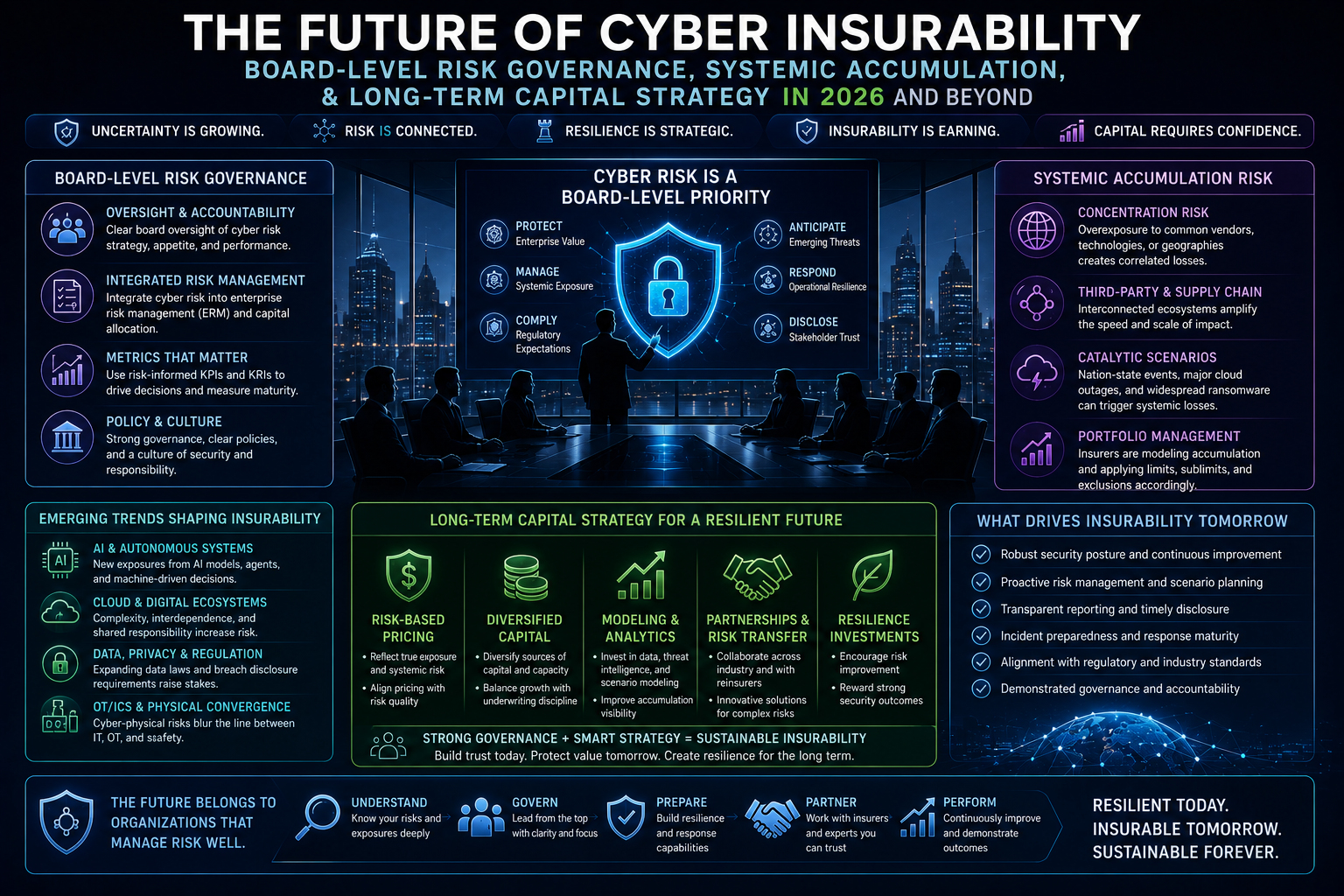
As cyber threats evolve into systemic, nation-state, and AI-driven risks, cyber insurance has transitioned from a basic risk-transfer product into a strategic benchmark of corporate governance. Insurers no longer evaluate security in isolation; they analyze how executive leadership, board members, and capital allocation frameworks manage digital risk as a fundamental core business risk.
Entering the late 2020s, the primary challenge facing the cyber insurance market is systemic risk accumulation—the concentration of financial liability across interconnected cloud networks, global software supply chains, and post-quantum cryptographic exposures. To maintain long-term insurability and secure high-limit coverage, enterprise boardrooms must adopt integrated risk governance models, leverage alternative risk transfer mechanisms (such as captive insurance), and embed cyber resilience directly into capital allocation strategies.
This final technical guide synthesizes the key themes of the 17-part series, detailing board-level risk governance baselines, alternative risk transfer models, future underwriting trends, and a comprehensive CISO/CIO roadmap for long-term insurability.
The Systemic Risk Landscape: The Accumulation Challenge
The fundamental issue in modern cyber underwriting is the risk of correlated, catastrophic losses occurring simultaneously across thousands of policyholders.
Correlated Accumulation Vectors:
- Hyper-Concentrated Cloud Infrastructure: Outages or compromises at dominant cloud service providers that disrupt entire global industry sectors.
- Cascading Supply Chain Software Vulnerabilities: Single software component flaws that instantly expose tens of thousands of corporate networks worldwide.
- Systemic Cryptographic Obsolescence: Quantum computing capabilities invalidating legacy asymmetric encryption protocols across all global financial and defense infrastructure.
Board-Level Governance & Underwriting Expectations
Underwriters evaluate corporate board oversight as a primary indicator of enterprise risk management maturity:
| Governance Domain | Legacy Practice | Modern Governance Standard |
| Board Oversight | Annual security status presentations | Dedicated cyber risk committees with independent cybersecurity advisors |
| Risk Measurement | Qualitative scoring (Red/Yellow/Green) | Quantitative risk modeling (e.g., FAIR framework, Monte Carlo loss projections) |
| Capital Strategy | Pure reliance on commercial insurance | Hybrid risk transfer using captive insurance, parametric triggers, and cyber bonds |
| Regulatory Compliance | Annual compliance checkboxes | Continuous regulatory disclosure compliance (SEC, CISA, EU NIS2/DORA) |
Alternative Risk Transfer (ART): Beyond Traditional Insurance
To counter rising insurance premiums and policy exclusions, forward-thinking enterprises are building alternative risk transfer structures:
- Single-Parent & Group Captive Insurers: Forming specialized, enterprise-owned insurance subsidiaries to fund predictable first-party cyber risks while retaining commercial insurance solely for catastrophic excess losses.
- Parametric Cyber Coverage: Utilizing automated, index-based insurance policies that payout automatically based on pre-defined objective triggers (e.g., verified cloud network downtime exceeding 12 hours) without lengthy forensic claims adjusting.
- Insurance-Linked Securities (ILS) & Cyber Bonds: Accessing broader capital markets through insurance-linked bonds to cover extreme, tail-risk events such as global grid failures or widespread infrastructure collapse.
Real-World Executive Case Scenarios: Strategic Risk Governance
Scenario A: Coverage Reduction Due to Inadequate Board Oversight
- The Incident: A multinational retailer suffered a massive data breach originating from an unmonitored vendor portal. Regulatory filings revealed the board of directors had rejected recommended identity security budgets three quarters in a row without documented risk justification.
- The Insurance Outcome: Upon policy renewal, commercial carriers reduced the enterprise’s maximum coverage limit from $50M to $15M and doubled deductible requirements, citing deficient board-level risk governance.
Scenario B: Optimizing Capital Strategy via Captive Insurance Integration
- The Incident: A global financial technology conglomerate formed a pure captive insurance company to retain first-dollar losses up to $10M, while purchasing commercial excess coverage for catastrophic losses up to $100M.
- The Insurance Outcome: By demonstrating robust board governance, quantitative loss modeling, and proactive post-quantum readiness, the firm reduced overall cyber risk transfer costs by 22% while securing broader coverage terms.
The Master CISO & Board Executive Roadmap for Long-Term Insurability
To conclude this series, enterprise security and executive leaders should implement this comprehensive 5-pillar roadmap to ensure continuous insurability:
- Quantify Cyber Risk in Financial Terms: Transition security reporting from technical vulnerability counts to financial loss distribution models that quantify maximum probable loss (MPL) for the board and underwriters.
- Operationalize Crypto-Agility & Post-Quantum Preparedness: Maintain a real-time Cryptographic Bill of Materials (CBOM) and execute migration pathways toward NIST-approved post-quantum standards to avoid legacy protocol exclusions.
- Enforce Continuous Threat Exposure Management (CTEM): Replace point-in-time security audits with automated, continuous monitoring of internal networks, third-party software supply chains (SBOMs), and identity infrastructure (ITDR).
- Structure a Hybrid Risk Transfer Portfolio: Combine commercial cyber insurance with captive insurance structures and parametric policies to optimize coverage efficiency and manage market capacity fluctuations.
- Align Legal, Technical, & Crisis Response Frameworks: Pre-clear carrier-approved incident response panels, establish strict breach notification protocols under legal privilege, and conduct bi-annual executive tabletop exercises.
Frequently Asked Questions (FAQs)
What is a captive insurance company in the context of cyber risk?
A captive insurance company is a licensed insurance subsidiary created and owned by a parent corporation to insure its own risks, allowing the enterprise to retain lower-tier risks self-sufficiently while using commercial insurance for major catastrophic coverage.
How does systemic risk affect cyber insurance coverage limits?
Because catastrophic events (like cloud provider outages or post-quantum encryption failure) threaten many policyholders at once, insurers reduce coverage limits and introduce specific exclusions to avoid carrier insolvency.
What is the value of quantitative risk modeling (like FAIR) for insurance renewals?
Quantitative loss modeling translates technical security posture into financial terms (e.g., probable financial loss in dollars), giving underwriters clear, objective data to justify lower risk premiums and higher coverage limits.