Published: September 2026 | Technical Risk & Insurance Strategy Guide
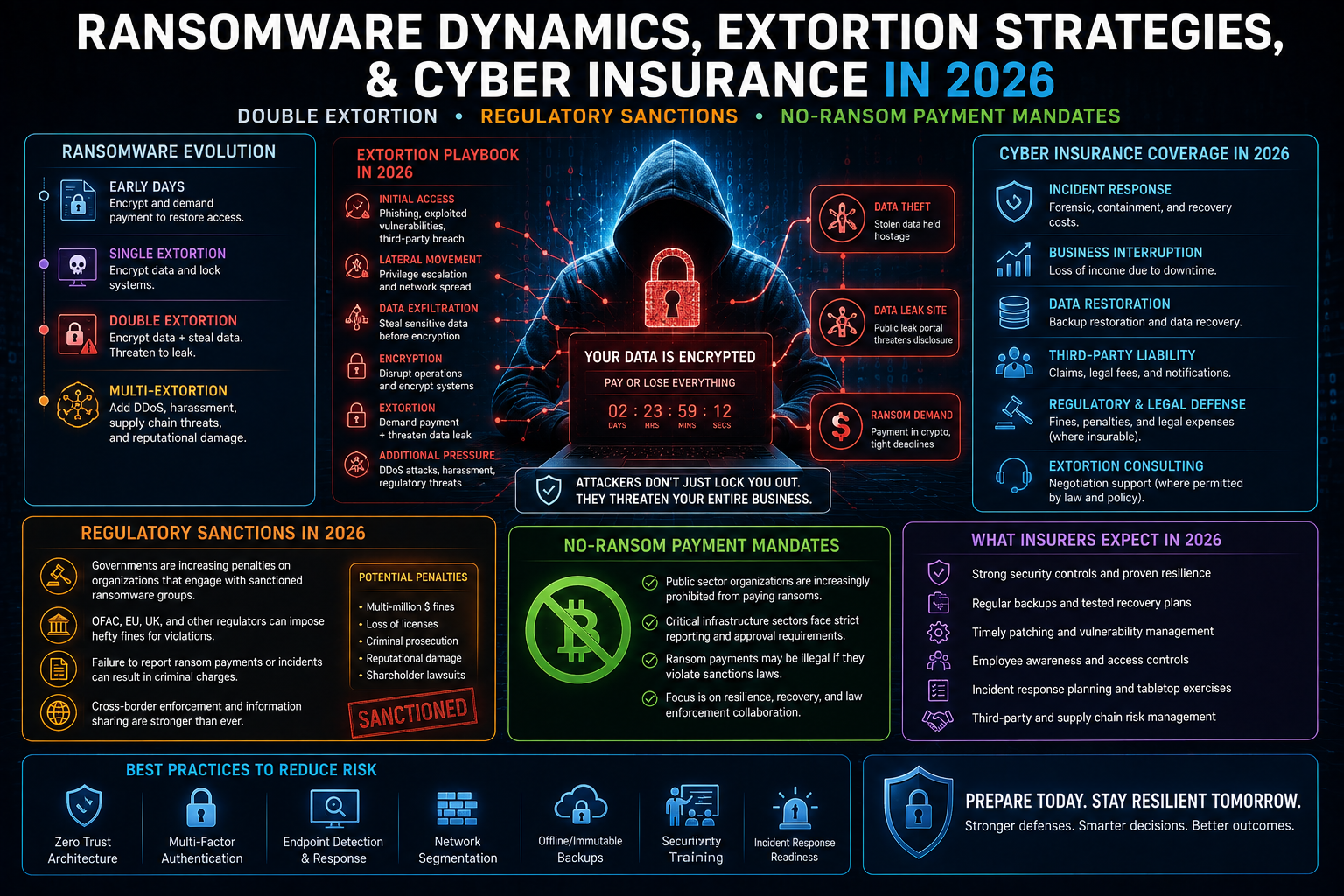
Ransomware has evolved from simple file-encrypting malware into complex, multi-tiered cyber extortion campaigns. Threat actors routinely execute double extortion (encrypting systems while exfiltrating sensitive data) and triple extortion (harassing customers, employees, or regulators directly).
Concurrently, legal and regulatory environments have shifted dramatically. Governments and insurance regulators are enforcing strict anti-money laundering (AML) protocols and considering outright bans on ransom payments to disrupt the cybercrime business model. Consequently, cyber insurance carriers are restructuring ransomware coverage by introducing strict payment pre-approval protocols, coinsurance requirements, and ransomware-specific sub-limits.
This technical guide provides a detailed analysis of modern ransomware dynamics, regulatory compliance around extortion payments, underwriting mandates for ransomware resilience, real-world case scenarios, and a strategic CISO framework to preserve enterprise insurability.
The Evolving Extortion Landscape: Double vs. Triple Extortion
Attackers have shifted their monetization methods away from basic decryption keys toward high-pressure extortion vectors.
Phase 1: Exfiltration & System Encryption (Double Extortion)
- Attackers exfiltrate intellectual property and sensitive customer records before launching network-wide encryption binaries to maximize leverage.
Phase 2: Direct Victim & Stakeholder Harassment (Triple Extortion)
- Threat actors contact clients, media outlets, and regulatory bodies directly, threatening to leak sensitive data if the victim delays payment.
Phase 3: Destruction & Distributed Denial of Service (DDoS)
- Threat actors launch localized DDoS attacks against target systems to pressure executive leadership during active ransom negotiations.
Regulatory Compliance & Legal Sanctions Framework
Paying a ransom carries severe legal and financial risks under international sanction enforcement frameworks:
| Regulatory Mechanism | Regulatory Body | Operational Impact on Ransomware Claims |
| OFAC Sanctions Enforcement | U.S. Department of the Treasury | Strict liability penalties if a ransom is paid to sanctioned threat actors or nation-states. |
| Mandatory Breach Reporting | CISA / SEC / GDPR Bodies | Mandatory incident disclosure windows (e.g., 24–72 hours) regardless of payment status. |
| Ransom Payment Restrictions | State & National Legislatures | Growing bans on state agencies and critical infrastructure paying ransoms under any circumstance. |
Underwriting Compliance Baseline for Ransomware Mitigation
Insurance underwriters demand proof that organizations can withstand a ransomware attack without needing to pay a ransom:
- Immutable & Air-Gapped Backups: Mandatory use of write-once-read-many (WORM) storage, air-gapped offline backups, and isolated cloud vaults that cannot be wiped or altered by compromised admin accounts.
- Endpoint Detection & Response (EDR/XDR): 24/7 endpoint coverage with active isolation capabilities to kill ransomware processes automatically before lateral movement occurs.
- Strict Remote Desktop Protocol (RDP) Controls: Total elimination of internet-facing RDP ports without Zero Trust Network Access (ZTNA) or multi-factor authentication.
Policy Terms, Coinsurance, & Ransom Payment Provisions
Insurers are introducing specific coverage structures to limit their payout exposure:
- Ransomware Coinsurance Clauses: Requires policyholders to pay a percentage (e.g., 20% to 50%) of all extortion losses or business interruption costs out of pocket.
- Pre-Approval & Forensic Sanction Screening Endorsements: Explicit terms stating that no ransom reimbursement will be provided unless approved by the carrier and vetted by a licensed digital forensics firm to verify OFAC compliance.
- Encrypted Data Restoration Sub-Limits: Caps maximum coverage payouts for data reconstruction if the policyholder relies on a threat actor’s decryption tool rather than internal backup restoration.
Real-World Case Scenarios: Ransomware Claims & Insurance Disputes
Scenario A: Claim Rejected Due to OFAC Sanction Violation
- The Incident: A global logistics company suffered a double-extortion ransomware attack. The company retained a private negotiator and paid $4,000,000 to suppress exfiltrated data without prior insurer authorization.
- The Insurance Outcome: Subsequent forensic analysis revealed the wallet belonged to a sanctioned cybercrime group. The carrier denied reimbursement under the policy’s “Sanctions Limitation and Exclusion Clause.”
Scenario B: Rapid Restoration Avoids Ransom Payment
- The Incident: A regional manufacturing firm was hit by a double-extortion attack that encrypted primary cloud servers. Because the firm maintained immutable WORM backups and automated EDR isolation, systems were fully restored in 48 hours without communicating with the attackers.
- The Insurance Outcome: The insurer paid 100% of the forensic and incident response costs ($350,000) and granted a 10% policy renewal discount for zero ransom dependency.
CISO Action Plan for Ransomware Resilience
To pass stringent underwriting reviews and eliminate reliance on extortion payments, security leaders should execute the following 4-step framework:
- Deploy Immutable WORM Backups: Store production backups in isolated, immutable vaults with separate access controls to ensure data cannot be deleted or encrypted during an intrusion.
- Eliminate Internet-Exposed Administrative Ports: Enforce Zero Trust remote access policies, blocking direct internet exposure for RDP, SSH, and management consoles.
- Establish Sanction-Compliant Incident Protocols: Create an incident playbook detailing mandatory steps for digital forensics, legal counsel review, and carrier notification prior to engaging in any threat actor communication.
- Conduct Regular Disaster Recovery Drills: Perform unannounced system recovery tests to verify that full enterprise operations can be restored from offline backups within defined Recovery Time Objectives (RTO).
Frequently Asked Questions (FAQs)
What is double extortion in a ransomware attack?
Double extortion occurs when threat actors both exfiltrate sensitive enterprise data and encrypt internal systems, threatening to leak the stolen files publicly if the ransom is not paid.
Can an insurer reimburse a ransom payment if the attacker is sanctioned?
No. Paying a sanctioned entity violates international laws and sanctions (such as OFAC regulations), making reimbursement illegal for insurance carriers.
What is immutable backup storage?
Immutable backup storage uses write-once-read-many (WORM) technology to ensure that once backup data is written, it cannot be modified, encrypted, or deleted by anyone—including compromised domain administrator accounts.