Published: September 2026 | Technical Risk & Insurance Strategy Guide
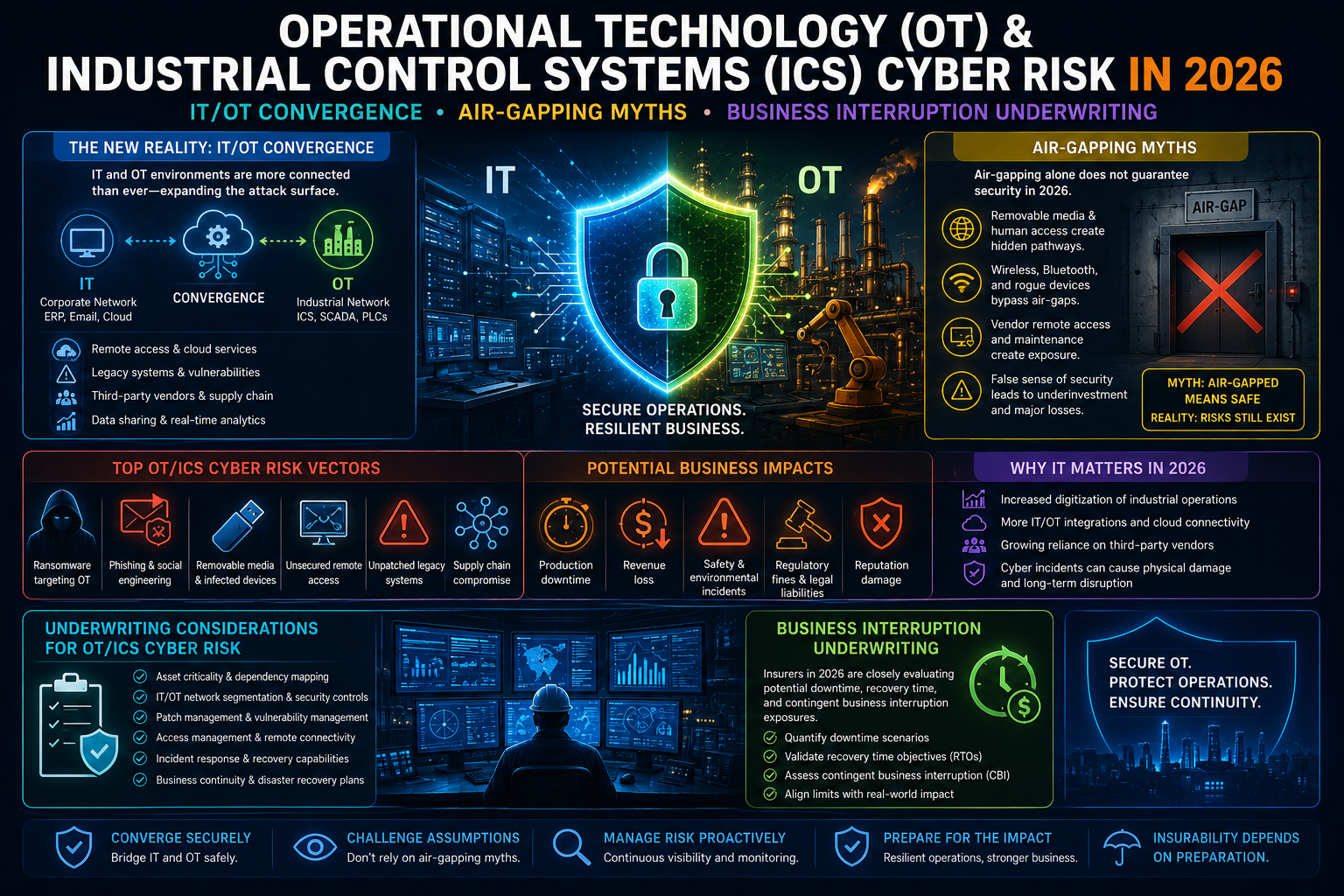
As manufacturing plants, energy grids, logistics hubs, and critical infrastructure increasingly connect operational technology (OT) and industrial control systems (ICS) to corporate IT networks, the air-gapping defense strategy has become largely obsolete. Threat actors are exploiting converged IT/OT attack surfaces to deploy ransomware, manipulate industrial processes, and cause physical operational disruption.
Because OT breaches directly translate into catastrophic physical losses, safety hazards, and multi-million-dollar business interruption claims, insurance carriers have radically tightened underwriting standards for industrial organizations. To secure coverage without restrictive sub-limits, enterprises must prove strict network segmentation, continuous OT threat monitoring, and specialized incident response capabilities.
This technical guide analyzes the evolving IT/OT threat landscape, mandatory underwriting requirements for industrial networks, coverage exclusions for legacy controllers, real-world case scenarios, and a practical mitigation framework for security leaders.
The Converged IT/OT Threat Landscape
Modern operational environments rely on data exchange between enterprise resource planning (ERP) systems and field-level controllers, creating entry points for cyber threats.
Key Cyber Vectors in OT Environments:
- IT-to-OT Lateral Movement: Ransomware entering through corporate email or cloud platforms and migrating across unsegmented networks into Supervisory Control and Data Acquisition (SCADA) systems.
- Compromised Remote Access: Unmonitored vendor maintenance portals and legacy VPNs exploited to manipulate Programmable Logic Controllers (PLCs).
- Legacy System Vulnerabilities: Outdated operating systems and unpatched embedded firmware running on legacy equipment that cannot support traditional security agents.
Underwriting Compliance Baseline for Industrial & OT Security
Insurance carriers evaluate OT security controls rigorously before issuing business interruption and property damage coverage:
| Compliance Domain | Legacy Approach | 2026 Underwriting Standard |
| Network Architecture | Assumed air-gapped networks | Verified Purdue Model micro-segmentation with zero-trust firewalls |
| Asset Visibility | Manual spreadsheets of physical hardware | Passive, automated OT asset discovery and continuous network monitoring |
| Remote Maintenance | Static third-party VPN access | Ephemeral, session-recorded Just-In-Time (JIT) vendor access |
| Disaster Recovery | Standard IT backup protocols | Validated, offline OT/ICS configuration backups and tested restore procedures |
Policy Provisions & Exclusions for OT/ICS Infrastructure
Insurers are introducing specific clauses to limit systemic exposure across industrial manufacturing and infrastructure sectors:
- Unsegmented OT/IT Network Exclusion: Limits or denies business interruption coverage if a ransomware event originates in the corporate IT environment and spreads unhindered into the production network due to missing network segmentation.
- End-of-Life (EOL) Controller Sub-Limits: Applies reduced payout caps or higher deductibles for incidents targeting deprecated SCADA software or unsupported hardware components.
- Physical Property Damage Endorsements: Clarifies the boundary between standard cyber policies (which cover digital assets and revenue loss) and property insurance policies (which handle physical equipment destruction caused by a cyber incident).
Real-World Case Scenarios: OT Compromise & Claim Claims
Scenario A: Business Interruption Claim Denied Due to Flat Network
- The Incident: Attackers gained initial access to a manufacturing firm’s corporate network via a phishing attack. Due to a flat network topology, ransomware quickly spread to production line PLCs, halting operations for two weeks.
- The Insurance Outcome: The insurer rejected the $10,000,000 Business Interruption claim under the policy’s “Mandatory Network Segmentation Clause,” as the firm failed to isolate its IT systems from the OT environment.
Scenario B: Full Payout Secured via Passive OT Telemetry
- The Incident: A regional water utility experienced a targeted lateral movement attempt. Passive OT network monitoring tools detected anomalous commands directed at water treatment controllers and automatically isolated the affected network segment.
- The Insurance Outcome: The incident was contained in less than two hours with zero operational downtime. The cyber insurance carrier covered the $150,000 forensic audit in full and maintained optimal renewal pricing.
CISO Action Plan for OT/ICS Insurability
Security leaders overseeing industrial environments should execute the following roadmap to ensure comprehensive coverage and operational resilience:
- Enforce Micro-Segmentation: Implement strict firewall rules and network zoning between IT, SCADA, and field-level equipment based on the Purdue Model framework.
- Deploy Passive OT Discovery Tools: Utilize non-intrusive network monitoring solutions to maintain real-time visibility over legacy controllers and continuous threat detection.
- Secure Vendor Remote Access: Eliminate persistent remote access tools in favor of identity-centric Zero Trust solutions with mandatory multi-factor authentication and session logging.
- Test OT-Specific IR Plans: Conduct regular table-top exercises simulating ransomware attacks on production environments, including cold-start recovery testing from offline backups.
Frequently Asked Questions (FAQs)
Why are traditional security agents unsuitable for OT networks?
Many OT devices (like PLCs and RTUs) run on low-power, proprietary embedded systems that cannot handle traditional EDR agents, making passive network traffic analysis the primary method for security monitoring.
What is the Purdue Model in OT security?
The Purdue Model is a structural framework that divides industrial automation systems into distinct hierarchical zones (from field sensors at Level 0 to corporate IT at Levels 4/5) to control network traffic and prevent unauthorized access.
How does Contingent Business Interruption apply to OT networks?
If a cyber incident at a key supplier or utility provider forces your production facility to shut down, Contingent Business Interruption (CBI) helps cover the resulting financial revenue losses.