Published: September 2026 | Technical Risk & Insurance Strategy Guide
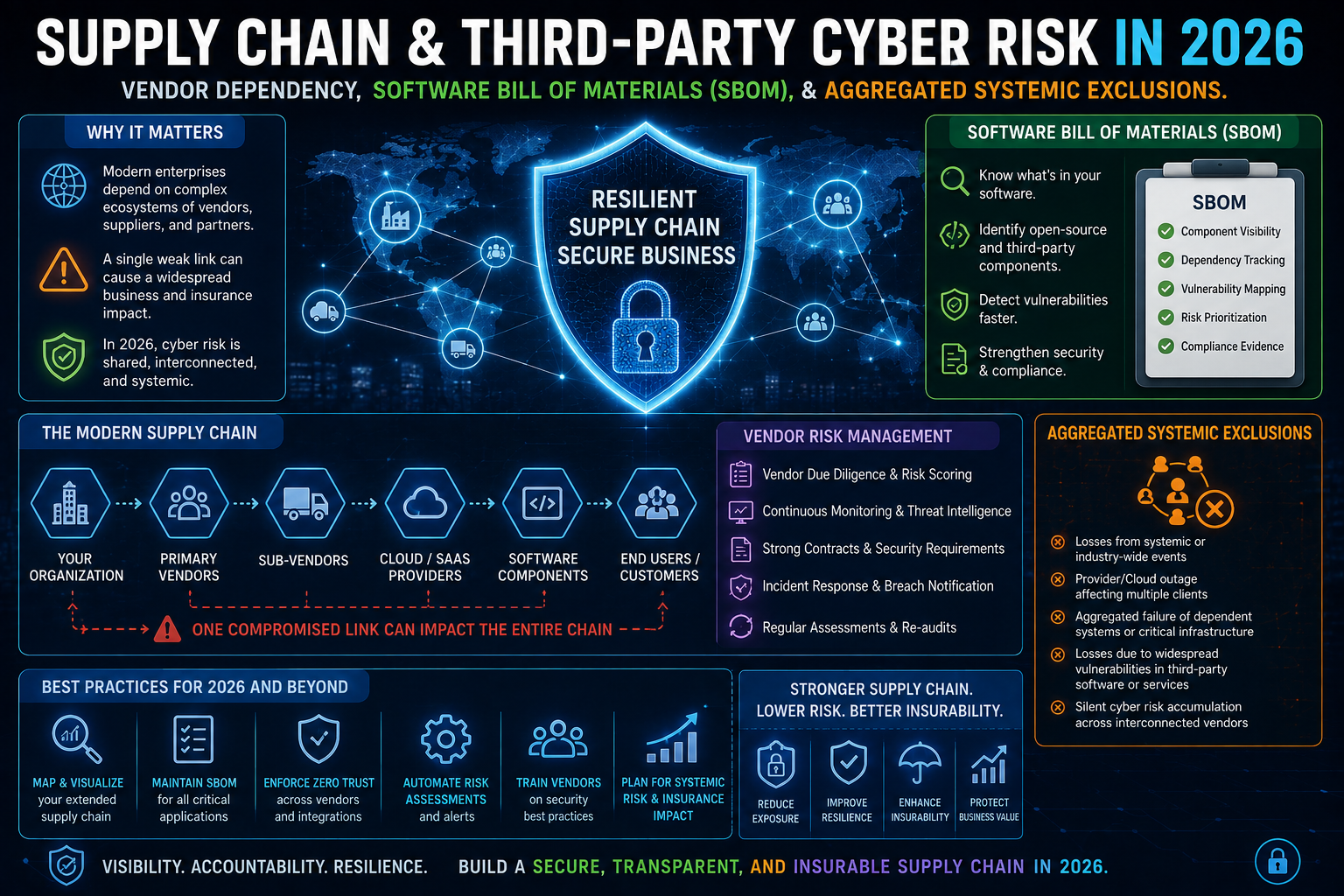
Modern enterprises rely heavily on vast networks of cloud providers, managed service providers (MSPs), SaaS platforms, and third-party software libraries. While this ecosystem accelerates operational efficiency, it also introduces severe supply chain vulnerabilities. A single breach at a critical vendor can trigger cascading security failures across thousands of downstream organizations.
To manage systemic exposure, cyber insurance underwriters have shifted from evaluating isolated corporate networks to analyzing complete digital supply chain ecosystems. Insurers now require mandatory Software Bill of Materials (SBOM) tracking, third-party risk management frameworks, and strict vendor security assessments. Furthermore, policies are increasingly featuring aggregated systemic risk exclusions for cloud outages and widespread software exploits.
This technical guide covers supply chain risk vectors, underwriting standards for vendor ecosystem governance, policy endorsements, real-world claim scenarios, and an actionable CISO mitigation framework.
The Supply Chain Risk Landscape: Direct vs. Cascading Exposures
Supply chain attacks exploit trusted relationships between organizations and their third-party providers.
Direct Vendor Vulnerabilities:
- Exploitation of unpatched software components and open-source dependencies (e.g., Log4j-style library flaws).
- Compromised Managed Service Providers (MSPs) used as launchpads for downstream customer breaches.
- Stolen vendor credentials used to access target networks via trusted API integrations.
Cascading Systemic Risks:
- Outages at major cloud service providers (CSPs) causing simultaneous business interruption across multiple industries.
- Widespread zero-day exploits impacting core enterprise software solutions simultaneously.
- Cross-border vendor data breaches resulting in regulatory non-compliance fines.
Underwriting Compliance Baseline for Third-Party Risk
Insurers require strict oversight of external software and service dependencies before issuing high-limit supply chain coverage:
| Compliance Area | Legacy Expectation | 2026 Underwriting Standard |
| Software Asset Management | Basic software inventories | Comprehensive, machine-readable Software Bill of Materials (SBOM) |
| Vendor Risk Assessments | Annual vendor questionnaires | Continuous automated monitoring of vendor attack surfaces |
| Privileged Access for Vendors | Permanent VPN/remote access | Zero Trust network access (ZTNA) with Just-In-Time (JIT) scoping |
| Incident Response Alignment | Internal IR plans only | Joint vendor-enterprise IR exercises and contractual SLA tracking |
Anatomy of Supply Chain Policy Exclusions & Endorsements
Insurers are refining policy language to limit their exposure to widespread, correlated supply chain events:
- Systemic Outage Exclusions: Limits or excludes business interruption coverage resulting from prolonged outages of major global cloud infrastructure, unless specific contingent business interruption (CBI) endorsements are purchased.
- Unmonitored Vendor Dependency Exclusions: Denies claims stemming from a vendor breach if the policyholder failed to perform mandatory contractual risk reviews or enforce MFA on vendor access channels.
- Contingent Business Interruption (CBI) Sub-Limits: Caps maximum insurance payouts for revenue losses caused by operational downtime at key third-party service providers.
Real-World Case Scenarios: Vendor Compromise & Claim Outcomes
Scenario A: Claim Denial Due to Unenforced Vendor Access Controls
- The Incident: Threat actors compromised a third-party HVAC vendor’s credentials to gain access to a retail chain’s corporate network, deploying ransomware across 2,000 POS terminals.
- The Insurance Outcome: The insurer denied full coverage under the policy’s “Third-Party Access Control Endorsement,” citing the retailer’s failure to enforce multi-factor authentication on the vendor’s dedicated access portal.
Scenario B: Full CBI Payout via Continuous Vendor Risk Monitoring
- The Incident: A SaaS platform used by a global financial firm suffered a multi-day outage due to a compromised CI/CD pipeline, halting customer transactions.
- The Insurance Outcome: Because the firm maintained a continuous vendor monitoring system and verified SBOM inventories, the insurer processed the $3,500,000 Contingent Business Interruption claim without penalty.
CISO Action Plan for Supply Chain Insurability
Security leaders should execute the following steps to protect their enterprise against vendor-related risks and maintain full insurance coverage:
- Maintain an Active SBOM Inventory: Implement automated tools to generate and update Software Bills of Materials for all custom-built and commercial software applications.
- Enforce Zero Trust Vendor Access: Replace broad network VPN access for external parties with granular, session-monitored Zero Trust solutions requiring phishing-resistant MFA.
- Automate Third-Party Risk Scoring: Transition from static vendor surveys to continuous digital risk monitoring services to detect third-party security posture degradation in real time.
- Negotiate Robust Security SLAs: Ensure all vendor contracts contain explicit requirements for rapid breach notification (e.g., within 24 hours) and mandatory security baseline compliance.
Frequently Asked Questions (FAQs)
What is a Software Bill of Materials (SBOM)?
An SBOM is a formal, structured inventory listing all components, libraries, and modules built into a software application, allowing security teams to instantly track newly discovered vulnerabilities across their software stack.
What is Contingent Business Interruption (CBI) coverage?
CBI covers financial losses resulting from operational downtime caused by a cyber incident at an external vendor, supplier, or cloud service provider that your business relies on.
Why are insurers limiting coverage for systemic cloud outages?
Because a major cloud provider outage can cause simultaneous losses for thousands of policyholders at once, creating an unmanageable concentration of financial risk for insurance carriers.