Published: September 2026 | Technical Risk & Insurance Strategy Guide
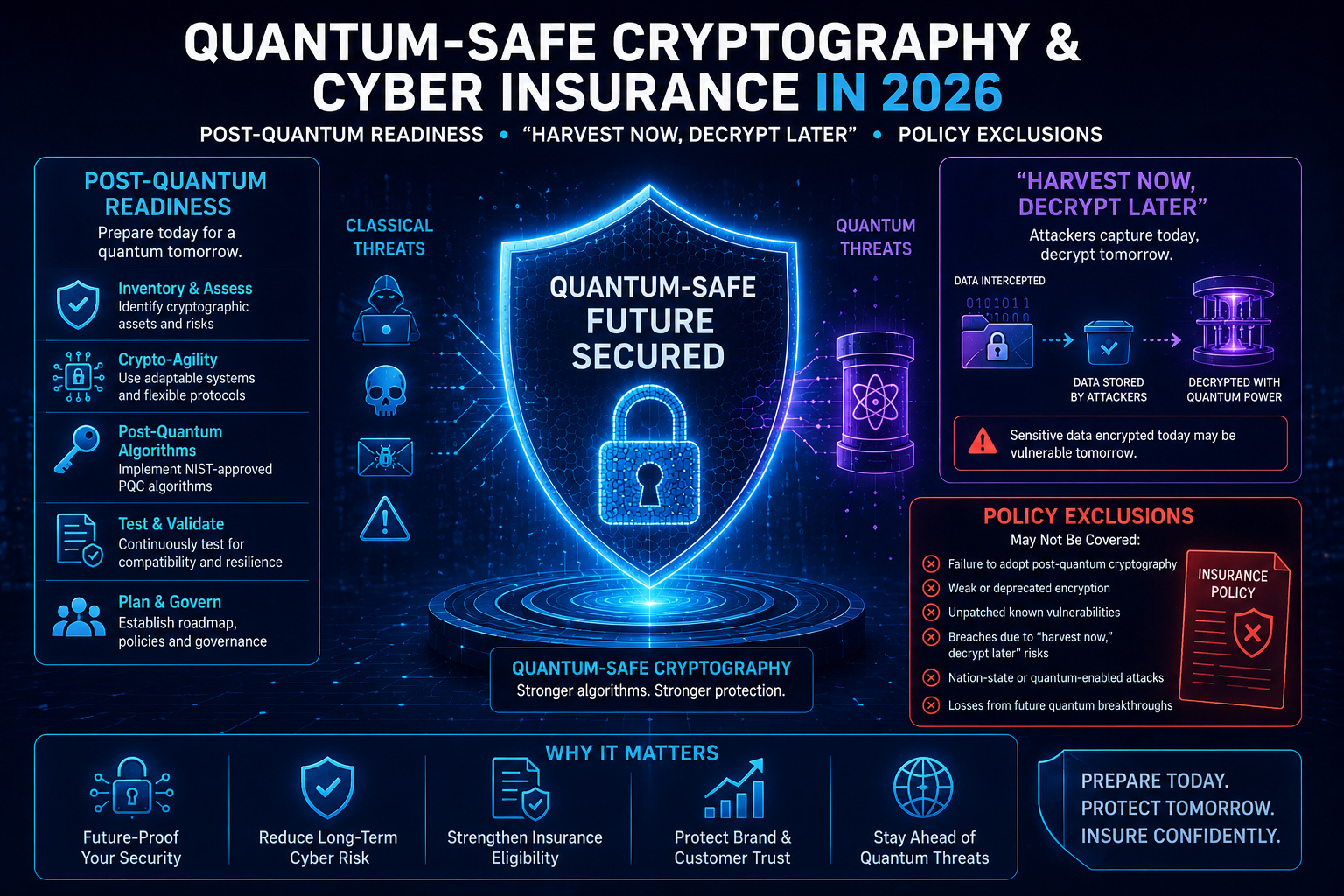
The rapid advancement of quantum computing hardware has transformed post-quantum cryptography (PQC) from a theoretical security concern into an immediate corporate risk management imperative. State-sponsored threat actors and cybercrime syndicates are actively executing “Harvest Now, Decrypt Later” (HNDL) attacks—intercepting and storing massive volumes of encrypted long-tail enterprise data, intellectual property, and classified communications today so they can decrypt them once a Cryptographically Relevant Quantum Computer (CRQC) becomes operational.
Legacy asymmetric encryption standards—such as RSA-2048, Elliptic Curve Cryptography (ECC), and Diffie-Hellman key exchanges—rely on mathematical problems (integer factorization and discrete logarithms) that can be solved in polynomial time by a CRQC using Shor’s Algorithm. To hedge against systemic cryptographic failure, insurance underwriters are updating their evaluation baselines, establishing post-quantum readiness requirements, and introducing specific exclusions for legacy cryptographic standards.
This technical guide provides an exhaustive analysis of the quantum threat timeline, HNDL attack mechanics, NIST Post-Quantum Cryptography standards, quantum risk underwriting requirements, real-world case studies, and migration frameworks required to maintain enterprise cyber insurance coverage.
The Quantum Threat Landscape: “Harvest Now, Decrypt Later” Mechanics
To evaluate post-quantum risk, enterprise security teams and Chief Information Security Officers (CISOs) must examine the lifecycle of quantum interception attacks.
Phase 1: Interception
- Intercept encrypted transit traffic via BGP hijacking or optical network taps.
Phase 2: Long-Term Storage
- Storage of exfiltrated data in immutable state data vaults.
Phase 3: Quantum Decryption
- Shor’s algorithm on CRQC breaks RSA/ECC keys, exposing plain data.
1. Passive Interception via BGP Hijacking & Optical Taps
Threat actors perform passive network sniffing, internet backbone tapping, and Border Gateway Protocol (BGP) route hijacking to capture encrypted TLS/SSL sessions, VPN tunnels, and inter-datacenter traffic flows. Target data includes proprietary designs, strategic M&A plans, sensitive health records, and defense contracts.
2. Data Shelf-Life vs. “Time-to-Quantum” Imbalance
The financial risk of HNDL is governed by Mosca’s Theorem ($X + Y > Z$). If the required secrecy lifetime of enterprise data ($X$) plus the time needed to migrate to post-quantum standards ($Y$) exceeds the estimated time until a CRQC emerges ($Z$), the organization’s encrypted data is already vulnerable to retroactive breach.
3. Retroactive Data Breach Liability
When CRQCs eventually crack archived encrypted datasets, the breach event occurs retroactively on the date the data was decrypted, yet the exposure stems from historical network compromise. Standard claims-made cyber policies create complex coverage disputes over when the loss officially manifested.
NIST Post-Quantum Cryptography (PQC) Standards Baseline
Following a multi-year global evaluation, the National Institute of Standards and Technology (NIST) finalized its primary post-quantum cryptographic standards. Insurers utilize these standards as the baseline for corporate cryptographic compliance:
| NIST Standard | Primary Algorithm Family | Cryptographic Purpose | Legacy Replacement Target |
| FIPS 203 | ML-KEM (CRYSTALS-Kyber) | General Encryption / Key Encapsulation | RSA Key Exchange, DH, ECDH |
| FIPS 204 | ML-DSA (CRYSTALS-Dilithium) | Primary Digital Signatures | RSA Digital Signatures, ECDSA |
| FIPS 205 | SLH-DSA (SPHINCS+) | Stateless Hash-Based Digital Signatures | RSA/ECDSA (Fallback mechanism) |
| FIPS 206 | FN-DSA (Falcon) | Compact Digital Signatures | ECDSA (High-performance constrained devices) |
Anatomy of Quantum-Safe Cyber Insurance Coverage
As quantum risks mature, insurers are restructuring policy language to separate standard software vulnerabilities from structural cryptographic obsolescence.
Covered Risk Units:
- HNDL Discovery Costs
- PQC Hybrid Transition
- Breach Counsel & Legal Notification
Quantum Exclusions:
- Un-migrated RSA legacy systems
- Failure to maintain Crypto Agility
Key Policy Provisions & Endorsements Explained
- Cryptographic Vulnerability Exclusions: Insurers are introducing policy exclusions that limit coverage for losses resulting from the compromise of deprecated asymmetric encryption algorithms (e.g., RSA key lengths below 2048 bits or un-patched ECC implementations) where the policyholder failed to execute a documented PQC migration plan.
- Retroactive HNDL Incident Endorsements: Specialized endorsements that clarify coverage for HNDL incidents, establishing that the “incident date” corresponds to the initial exfiltration event rather than the future decryption date, provided the policy remained continuously active.
- Crypto Agility & PQC Upgrade Sub-Limits: Forward-thinking policies offer affirmative sub-limits to fund forensic cryptographic audits and emergency crypto-agility middleware implementation following an identified cryptographic exposure.
Technical Underwriting Baseline Requirements for Post-Quantum Readiness
Underwriters require corporate applicants to demonstrate systematic cryptographic asset management before granting high-limit cyber liability coverage:
- Automated Cryptographic Discovery (CBOM): Applicants must maintain a real-time Cryptographic Bill of Materials (CBOM) mapping all encryption certificates, symmetric/asymmetric algorithms, key lengths, and data locations across enterprise assets.
- Hybrid Cryptographic Protocols: Implementation of dual-encapsulation hybrid TLS 1.3 key exchanges combining traditional ECDH with NIST ML-KEM to protect current transit traffic against HNDL while preserving legacy compatibility.
- Formal PQC Migration Roadmap: A verified executive plan aligned with federal guidance (e.g., U.S. NSM-10 / CISA PQC guidelines) detailing milestone dates for complete removal of quantum-vulnerable algorithms from core production pipelines.
Real-World Case Scenarios: Quantum Risk & Insurance Disputes
Case Study 1: Enterprise Denied Claim Over Legacy Cryptographic Exclusions
- The Target: A global pharmaceutical company holding multi-billion-dollar drug patent data.
- The Incident: Threat actors intercepted terabytes of encrypted R&D communications over a two-year period using network sniffing points. Subsequent investigations revealed the firm relied on deprecated RSA-1024 encryption across internal database sync tunnels.
- Financial Exposure: $12,000,000 in forensic remediation, legal disclosures, and data vault restructuring.
- The Outcome: The cyber insurance carrier denied coverage under the policy’s “Deprecated Cryptographic Standards Exclusion,” citing the company’s failure to upgrade to modern key lengths or implement a Cryptographic Bill of Materials (CBOM) despite prior policy renewal warnings.
Case Study 2: Financial Institution Secures Full Policy Limit via PQC Hybrid Protocol
- The Target: An international payment processing network.
- The Incident: A state-sponsored actor hijacked BGP routes, diverting transaction traffic through foreign servers. Because the network had implemented hybrid ML-KEM / ECDH encryption across all API gateways, the intercepted payload remained secure against future quantum decryption.
- Financial Exposure: $800,000 in BGP containment and incident response costs.
- The Outcome: The institution’s cyber policy covered 100% of the crisis management and route-remediation expenses. The carrier granted a 15% renewal premium reduction due to the firm’s documented crypto-agility posture.
Step-by-Step Post-Quantum Migration Framework for Enterprise Security
To satisfy cyber insurance underwriting standards and protect organizational data assets, CISOs must execute a structured post-quantum migration lifecycle:
- Discover and Generate a Cryptographic Bill of Materials (CBOM): Deploy automated network and code scanning tools to map every cryptographic asset, key pair, digital signature, and certificate across local, cloud, and third-party vendor environments.
- Classify Data by Secrecy Lifetime: Identify sensitive datasets requiring long-term confidentiality (e.g., medical history, trade secrets, sovereign intelligence) and prioritize their encryption pipelines for immediate PQC migration.
- Deploy Hybrid Key Exchange Protocols: Upgrade edge routers, web servers, and internal VPNs to support hybrid key encapsulation mechanisms (e.g., combining ECDH with NIST FIPS 203 ML-KEM) to safeguard active transit data against current HNDL collection.
- Architect for Crypto-Agility: Decouple cryptographic implementations from underlying application logic using security abstraction layers, enabling rapid algorithm swapping as standards evolve without requiring full system rebuilds.
- Conduct Periodic Third-Party Cryptographic Audits: Engage external security auditors to stress-test your crypto-agility frameworks and present verified compliance reports to cyber insurance carriers during annual policy renewal cycles.
Frequently Asked Questions (FAQs)
What is “Harvest Now, Decrypt Later” (HNDL)?
HNDL is an exploitation strategy where attackers intercept and store encrypted enterprise data today, waiting for the advent of a Cryptographically Relevant Quantum Computer (CRQC) to break the underlying asymmetric encryption (such as RSA or ECC) and reveal the plain data in the future.
How does Shor’s Algorithm threaten current encryption?
Shor’s Algorithm is a quantum algorithm capable of solving prime factorization and discrete logarithm problems in polynomial time. Once executed on a quantum computer with sufficient stable qubits, it will efficiently break widely used asymmetric encryption methods like RSA and ECC.
What is a Cryptographic Bill of Materials (CBOM)?
A CBOM is a structured inventory of all cryptographic assets within an enterprise, including algorithms, key sizes, certificates, protocols, and data locations. Insurers require a CBOM to verify post-quantum preparedness.
Are quantum breaches covered under existing cyber insurance policies?
Standard cyber policies cover current breach events, but insurers are increasingly adding exclusions for legacy encryption standards. To ensure coverage for HNDL scenarios, organizations must demonstrate compliance with post-quantum standards and maintain clear incident date definitions.
What is Hybrid Cryptography?
Hybrid cryptography combines a traditional encryption algorithm (like ECDH) with a post-quantum algorithm (like NIST ML-KEM) in a single key exchange. This ensures protection against both classical and quantum attacks during the transition period.