Published: September 2026 | Enterprise Security & Cyber Insurance Briefing
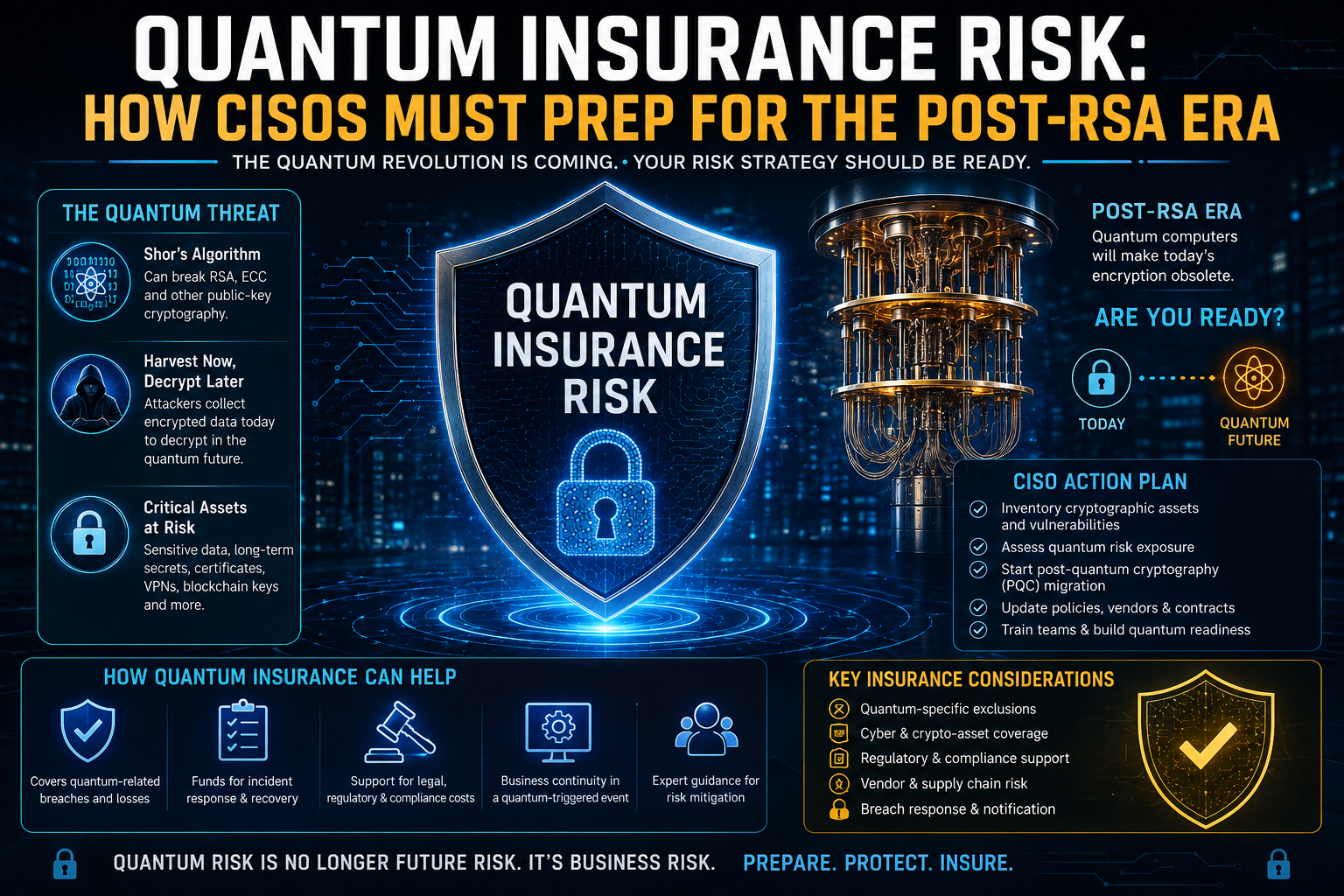
The threat of quantum computing breaking modern encryption isn’t a future scenario—it’s an operational risk affecting cyber insurance policies today. Adversaries are actively gathering encrypted corporate data via “Harvest Now, Decrypt Later” (HNDL), creating massive future breach liabilities for enterprises.
As underwriters adjust their policies, failure to demonstrate Post-Quantum Cryptography (PQC) readiness can lead to higher premiums, reduced coverage limits, or outright claim denials under new legacy protocol exclusions.
3 Core Drivers Changing Cyber Insurance Underwriting
- The HNDL Time-Bomb: Insurance carriers recognize that exfiltrated traffic captured today will be exposed the moment a Cryptographically Relevant Quantum Computer (CRQC) goes live.
- NIST Post-Quantum Standards: With NIST finalizing FIPS 203 (ML-KEM), 204 (ML-DSA), 205 (SLH-DSA), and 206 (FN-DSA), carriers now have an official baseline to measure corporate compliance.
- The Death of Legacy RSA/ECC: Symmetric keys remain relatively safe (AES-256), but legacy asymmetric key exchanges (RSA, Diffie-Hellman, ECC) are being classified as uninsurable structural vulnerabilities if left unmanaged.
Policy Exclusions vs. Affirmative Coverage
To protect your coverage, it is essential to understand what insurance policies will cover and what they will exclude moving forward:
| Policy Area | What’s Covered | What’s Excluded / Restricted |
| Data Interception (HNDL) | Interception costs if hybrid PQC key exchange was active during the breach event. | Claims arising from deprecated algorithms (e.g., RSA-1024/2048) without an executive migration plan. |
| Forensic & Legal | Investigations into retroactive data exposures under active, continuous policies. | Retroactive claims where data exfiltration occurred before policy inception on un-patched networks. |
| Crypto-Agility Remediation | Emergency sub-limits for deploying PQC middleware after a verified system audit. | Fines or losses caused by non-compliance with regional PQC security mandates. |
Real-World Impact Scenarios
Scenario A: The Deprecated RSA Penalty
A healthcare network suffers a data exfiltration attack. Investigations reveal that internal API tunnels relied on outdated RSA-1024 encryption. The insurer denies the $8M loss claim, citing failure to meet minimum cryptographic standards listed in the policy’s warranties.
Scenario B: The Hybrid Protocol Advantage
A global logistics provider updates its edge nodes to support hybrid TLS 1.3 (combining ECDH with NIST ML-KEM). During a BGP routing attack, data is intercepted but remains protected against future decryption. The insurer covers all $500k in containment costs and offers a 10% premium discount for verified crypto-agility.
The CISO Quantum Readiness Roadmap
To pass underwriting audits and secure optimal coverage limits, follow this 4-step action plan:
- Build a Cryptographic Bill of Materials (CBOM): Use automated discovery tools to map every certificate, key size, and encryption algorithm across cloud and local servers.
- Implement Hybrid Encryption: Upgrade public endpoints and internal VPNs to dual-encapsulation protocols to immediately stop current HNDL threats.
- Classify High-Value Data: Prioritize data with a long secrecy lifespan (IP, medical data, financial records) for immediate PQC migration.
- Establish Executive Oversight: Document a clear, board-approved PQC roadmap aligned with CISA and NIST guidance to present during annual insurance renewal reviews.
Quick Q&A
Why is AES-256 considered safe while RSA is not?
Grover’s algorithm only halves the effective key length of symmetric encryption, making AES-256 effectively quantum-safe. Shor’s algorithm, however, completely breaks asymmetric systems like RSA and ECC in polynomial time.
What is a Cryptographic Bill of Materials (CBOM)?
A CBOM is a structured inventory listing all encryption protocols, certificates, key lengths, and data paths across your organization. It serves as primary evidence of risk management for insurance underwriters.
How does Hybrid Encryption work?
Hybrid encryption wraps traditional classical algorithms (like ECDH) together with new post-quantum algorithms (like ML-KEM) in a single connection. Even if one algorithm fails, the other keeps the connection secure.